Skills Studio | Recovery Campus
Your Curriculum. A Place to Practice It.
Recovery skills deserve more than a handout after group. Skills Studio gives your virtual treatment program a dedicated room where participants can find your lessons, continue assignments, practice what they are learning, and see what comes next—all inside the same online facility they attend for treatment.
Bring your own curriculum in the base Skills Studio experience. When your program wants more, request activation of the advanced Recovery Dojo connection for expanded interactive learning, skill trees, rewards, badges, and guided progression.
A real destination for recovery skills—not another forgotten link
A participant leaves a session with a useful idea: pause before reacting, notice the early signs of stress, practice a difficult conversation, choose a different response when a craving arrives. But where does that learning live tomorrow? In a folder? A text thread? A separate site no one remembers to open?
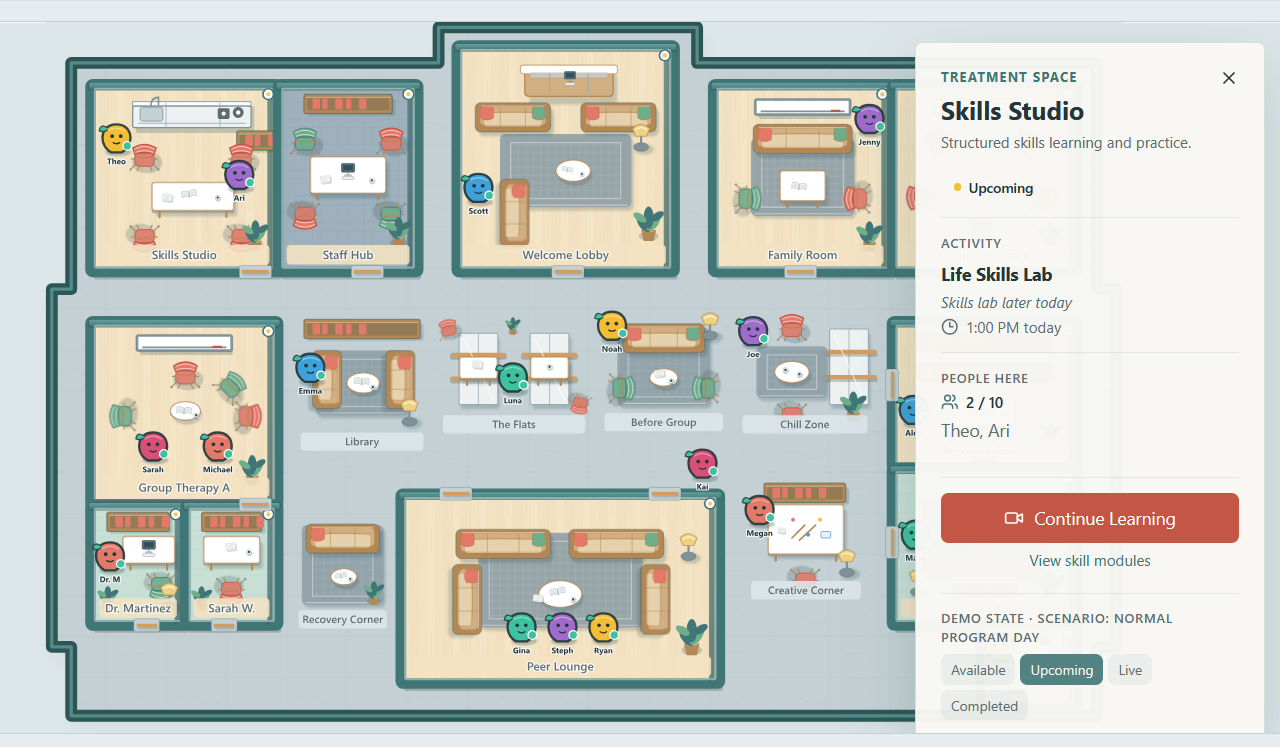
Skills Studio gives skill-building a recognizable home on Recovery Campus. From the campus map, participants can find the room, see its purpose, check whether an activity is upcoming or underway, notice who is there, and enter with a clear next action. The room is not a decorative label. It connects the setting of treatment to the actual work of learning and practice.
The room creates the place. Your program brings the learning. And, when enabled, Recovery Dojo extends how participants practice and progress.
See how Skills Studio works inside the facility
- Campus map
- Skills Studio room sidebar
- Learning dashboard
STEP 1 — Find Skills Studio on the Campus map. The actual room-entry screenshot shows a dedicated skills-learning space with an upcoming Life Skills Lab, 1:00 PM timing, participant presence, Continue Learning and View skill modules actions. A familiar destination makes “go practice your skills” concrete.
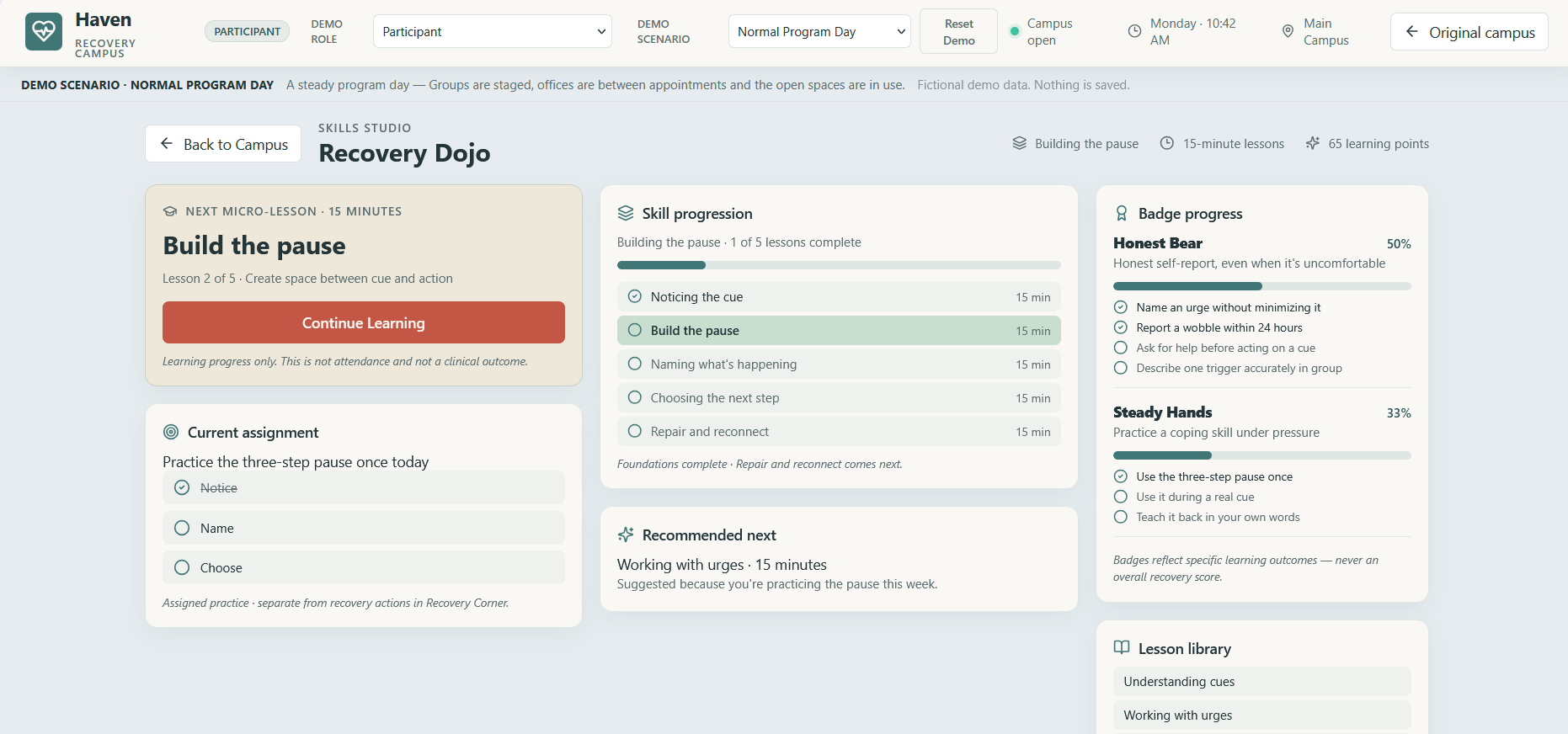
STEP 2 — Enter the learning experience. The second authentic screenshot illustrates a skills dashboard with a current micro-lesson, Build the pause, a 15-minute lesson length, a “Notice / Name / Choose” exercise, progression milestones, recommended next lessons, points and badges.
Start with the curriculum your program already believes in
No two treatment programs teach recovery in exactly the same way. One may have a carefully developed relapse prevention sequence. Another may emphasize emotional regulation, recovery planning, relationships, family work, or practical life skills. The base Skills Studio experience is the place for the client program to add its own learning materials and curriculum so participants can find them where treatment already happens.
Instead of scattering resources across email attachments, learning portals, PDFs and reminders, the program can organize its own educational content within a named location on Campus. Lessons, assignments, practice prompts and related materials can be given a consistent destination. Participants return to the same room, rather than relearning where to look every time a new activity is introduced.
Importantly, curriculum ownership and who administers content are still to be determined.
The learning opportunities buyers actually recognize
Skills Studio is not limited to the phrase “skills learning software.” Programs can use it to deliver real educational topics their staff already teach, including coping skills for addiction recovery, relapse prevention activities, emotion regulation, communication and boundaries, mindfulness and stress management, recovery planning, decision-making, healthy routines, relationship repair, and life-skills education.
Those familiar subjects provide the language people search for. The differentiator is what happens when that learning is no longer detached from the program: it has a place, a path back from group, and a next action the participant can recognize.
Make between-session practice part of the program
Group discussion is only the beginning of learning a skill. Repetition, reflection and real-life practice help people move from knowing an idea to trying it. Skills Studio offers a dedicated environment for that practice outside the group meeting without pretending that a digital lesson by itself proves behavior change.
Consider a participant who learns a three-step pause during group. Afterward, they return to Skills Studio, open a related lesson, follow a short sequence, and try “Notice / Name / Choose” once in ordinary life. The next time they meet their team, both can refer to the same practice. That is more specific and useful than “remember to work on coping skills.”
The learning pathway can be designed around topics such as recognizing cues, building the pause, naming what is happening, choosing the next step, and repairing or reconnecting. The visible screenshots provide a compelling example of how abstract skills can be broken into smaller steps.
Advanced option — Connect Skills Studio to Recovery Dojo
Programs that want a deeper learning experience can request activation of the advanced Recovery Dojo connection. It expands the standard Skills Studio experience rather than replacing it, and lets participants click through from the room into an expanded learning dashboard and skill tree.
- Interactive learning dashboard: a central place to see current lessons, next recommendations and learning activity.
- Skill tree and guided pathways: visible progression across related recovery skills, rather than a collection of unrelated assignments.
- Micro-lessons and practice: manageable learning segments, such as the 15-minute “Build the pause” example, connected to action-oriented exercises.
- Points, badges and rewards: recognition for participating in and progressing through learning, without presenting badges as measures of clinical recovery.
- Recommended next steps: help participants see where to go after finishing an activity.
No package-tier names or prices have been established. Activation is by client request.
Request a Personal DemoOne room, different reasons to value it
FOR PARTICIPANTS —
A place they can picture, a next step they can understand, and a repeatable path for learning at their own pace. Small learning units, progress cues and skill exercises can make abstract lessons feel more manageable.
FOR THERAPISTS —
A shared destination for follow-up. Instead of giving a vague reminder, a therapist can point to a particular topic or practice. Any visibility into completion or progress must be described in terms of the actual configured learning experience.
FOR GROUP FACILITATORS —
A way to connect group themes to work participants can revisit between sessions. A discussion about triggers, communication or emotion regulation can lead to relevant materials in Skills Studio.
FOR CARE COORDINATORS —
An easy way to help participants navigate back to their program activities and overcome the ordinary obstacles that interrupt follow-through. Care coordinators support engagement; they are not framed as owners of clinical curriculum or as EHR case managers.
FOR PROGRAM LEADERS —
A visible, consistent component of the treatment experience. Programs can use their own curriculum in a recognizable room while preserving flexibility over the content they deliver. More advanced learning engagement and reporting opportunities depend on the Recovery Dojo option and actual configuration.
What Skills Studio is—and is not
Skills Studio is where structured skills education and practice happen inside the Campus. It is different from the Resource Room, which is meant for open-ended, self-directed browsing of useful media, interests and practical information. It is also different from live Group Therapy: Skills Studio gives taught concepts somewhere participants can revisit and practice when the session ends.
It does not replace your EHR, guarantee better outcomes, or transform points and badges into measures of sobriety or clinical progress. A learning signal tells you about learning activity. Those boundaries matter to credible program operators.
A virtual treatment facility should have a place for learning
Recovery Campus gives a virtual treatment program an actual facility online. A facility is more than a map and more than a schedule: it contains distinct places for groups, everyday support, participant work, and skill-building. Skills Studio makes one of those places tangible. Staff can say “Go to Skills Studio,” and the participant knows where to go.
That familiarity helps a program feel connected. The participant sees where learning happens, the program supplies what it wants to teach, and the optional advanced experience gives providers a path toward more interactive skill progression.
Questions programs ask
Frequently Asked Questions
What is Skills Studio in Recovery Campus?
A dedicated room inside the virtual treatment facility where participants access structured skills education, practice materials and learning activities.
Can our program use its own curriculum?
Yes. In the base package, the client program adds its own content and educational materials to Skills Studio.
What is included in the advanced Recovery Dojo option?
Programs may request activation of a connected, expanded learning experience with a learning dashboard, interactive skill tree, rewards, badges and deeper guided progression.
Is Recovery Dojo required?
No. The Recovery Dojo connection expands Skills Studio; it does not replace the base experience.
Who manages and approves curriculum content?
That workflow is still to be determined. The program can supply content, but specific staff ownership and editing permissions have not been finalized.
Does Skills Studio replace group therapy?
No. It complements live groups and other program activities with a recognizable destination for learning and practice between sessions.
Do badges and points measure recovery outcomes?
No. They reflect learning activity and engagement with the experience; they are not attendance, clinical outcomes or an overall recovery score.
Can it support virtual IOP and other behavioral health programs?
Yes. Skills Studio is designed as a room in the wider virtual facility and can support different program curricula and formats.
Skills Studio | Recovery Campus
Your program already has something worth teaching. Give it a place to live.
Explore Skills Studio inside Recovery Campus. See how your own curriculum fits into the base experience—and ask how the advanced Recovery Dojo connection can expand learning with skill trees, interactive progression and rewards.