Peer Lounge | Inside Recovery Campus
When Group Ends, the Recovery Community Doesn't Disappear.
Give participants a place to hang out, chat, laugh, and connect with peers who understand recovery—inside your program's own virtual treatment facility. Whether someone wants company or lived-experience support, Peer Lounge is a place to go between sessions.
Current participants can spend time together alongside recovery coaches, Certified Peer Support Specialists, and trained peers who participate in the community—not only when leading scheduled activities. Approved alumni may also join under program-defined access rules. Structured conversations are optional; informal connection comes first.
A treatment facility is more than its therapy rooms
In a physical program, relationships form in the spaces between structured activities. People sit together before group, check on one another afterward, joke, ask questions, and find someone who has been through a similar experience. Those moments do not need a treatment plan to matter.
Virtual programs can lose that informal layer. A session ends and everyone goes back to separate homes and browser tabs. Peer Lounge gives the recovery community a recognizable place to exist between sessions—a room participants can picture, find on the Campus map, and return to whenever they want some company.
Recovery Campus gives a virtual treatment program an actual facility online. Peer Lounge helps that facility feel inhabited: people are there, conversations continue, and connection has a home.
Walk into Peer Lounge
- Campus map
- Peer Lounge room sidebar
- Peer Lounge dashboard
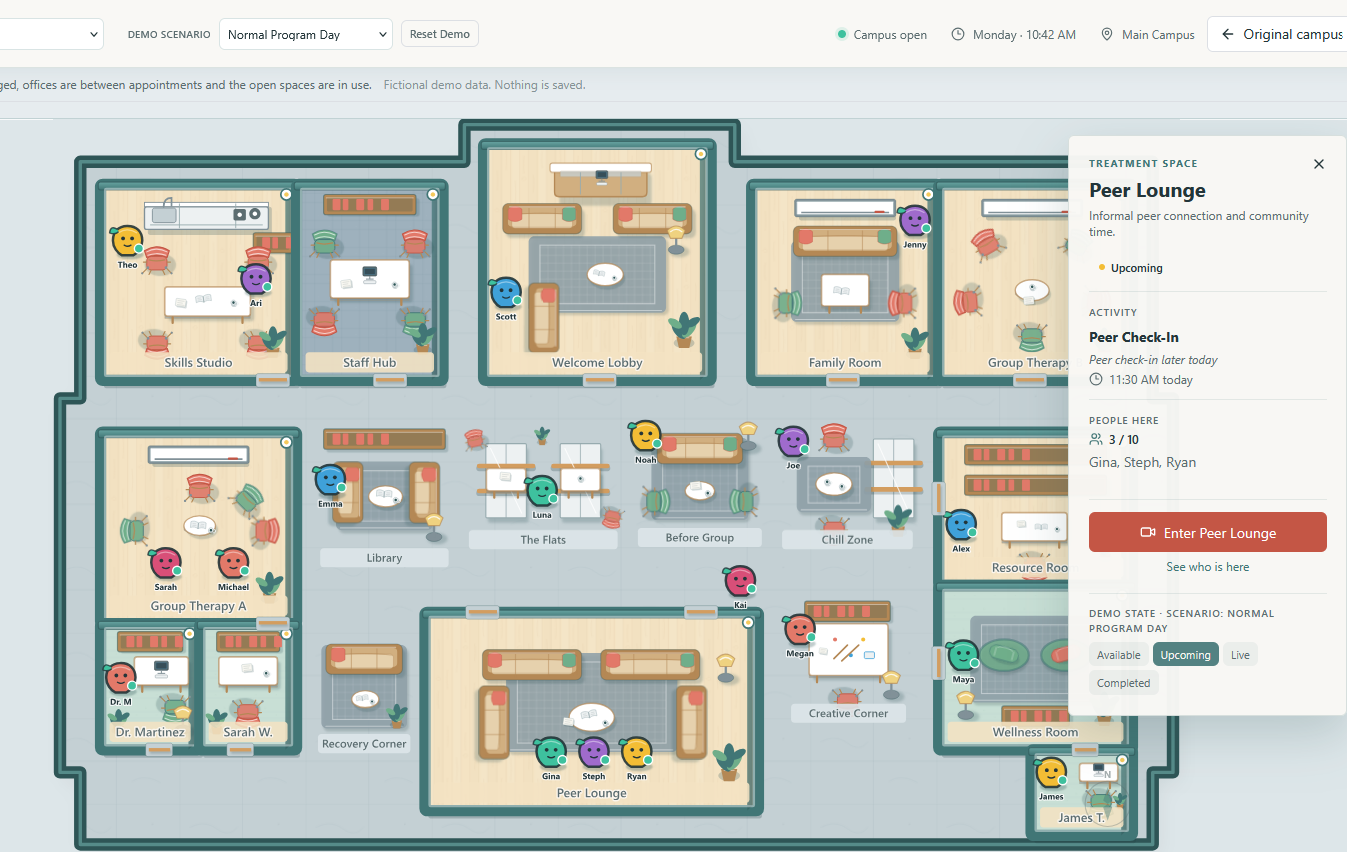
The experience starts on the Campus map: Peer Lounge is a visible, inhabited destination. Participants can see who is there before they enter, then choose Enter Peer Lounge or See who is here. The right-side panel also shows the next Peer Check-In, making the place feel active before anyone clicks inside.
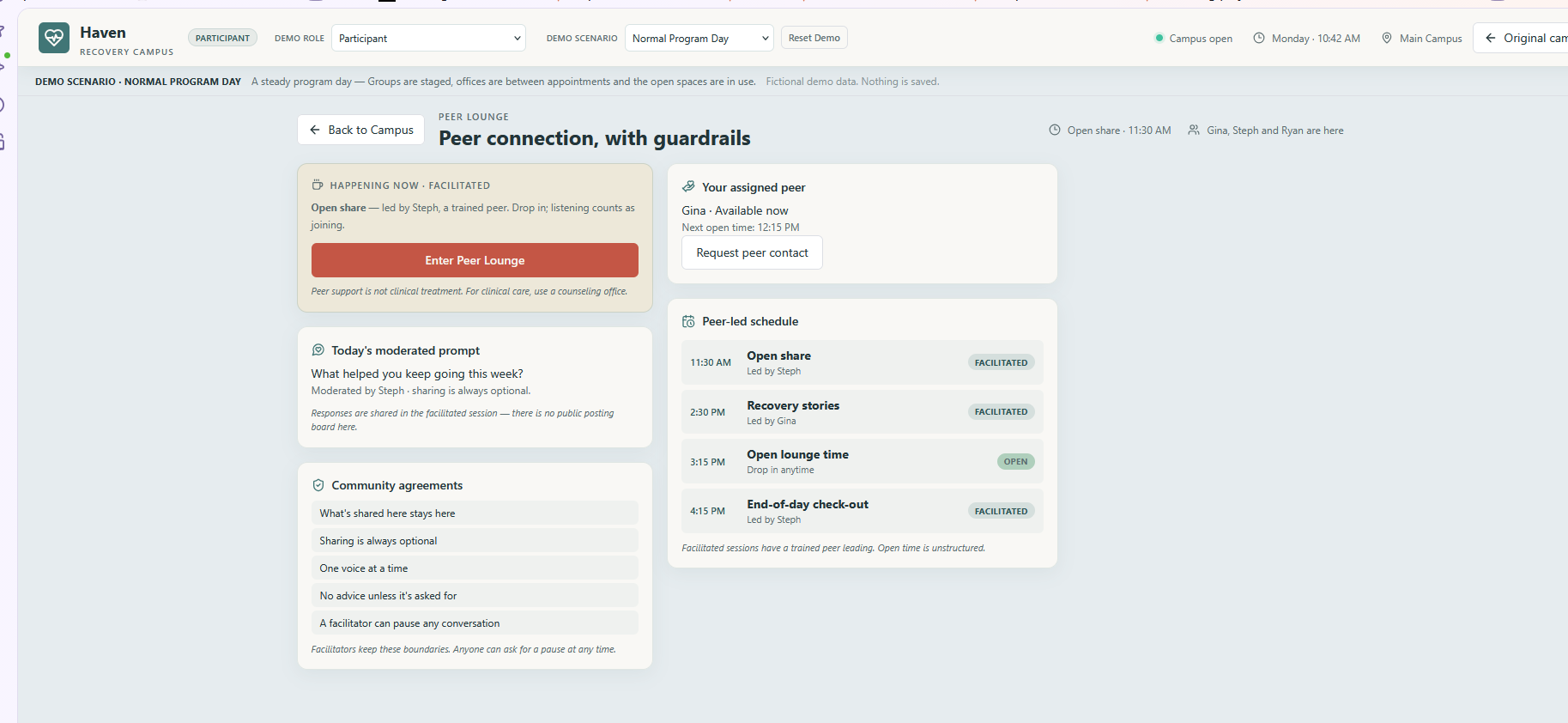
Inside, the current dashboard displays Open Share, an assigned peer available for contact, the peer-led schedule (including Open Lounge Time), an optional moderated prompt, and community agreements. These support the larger goal: people spending time together and being able to reach real peers when they want support.
A place to hang out—not another clinical session
Sometimes a participant needs guidance from a therapist. Other times they just want to talk to someone who understands. They might be bored, lonely, excited about a good day, or trying to get through a difficult afternoon. Peer Lounge makes room for ordinary human connection without treating every conversation as clinical care.
Peer support comes from people who bring lived recovery experience: Certified Peer Support Specialists, recovery coaches, trained peers, and alumni. They can be present in the lounge alongside participants—not only arrive to lead an event. That makes peer support visible, approachable, and part of everyday program life.
Participants can drop by, see who is around, join a live text conversation, hear recovery stories, request a peer contact, or connect during open lounge time. The room is not built around worksheets, assignments, or mandatory sharing.
What participants can do here
Drop in and chat.
Text-based lounge conversations let participants casually connect with people who are around. No video is included at this stage.
See who is here.
Visible presence helps participants know they are not entering an empty room and makes it easier to join a conversation.
Find lived-experience support.
An assigned peer and a request-peer-contact action give a participant a direct route to a trained peer or recovery coach when they want someone to talk to.
Join peer-led activities.
Open share, recovery stories, check-ins, and other scheduled text-based activities offer structure when participants want it.
Spend unstructured time together.
Open Lounge Time is for hanging out. It does not need a lesson objective or facilitator-led agenda.
Share—or just listen.
Participation is voluntary; the current room makes clear that listening counts. This lowers the pressure to speak before someone feels comfortable.
Know the boundaries.
Community agreements make expectations visible. Facilitators can pause a conversation when appropriate. Peer support remains distinct from clinical treatment.
Connection can begin before someone knows what to say
Picture a new participant who has not yet spoken much during group. They enter Peer Lounge and see a trained peer online and a prompt asking, "What helped you keep going this week?" They can read along, join a scheduled open share, or send a request to their assigned peer. On another day they might simply post a small win, reply to someone else, or hang out during open lounge time.
No single interaction promises recovery outcomes. The value is simpler: the participant has repeated opportunities to encounter supportive people, practice reaching out, and form relationships within their program rather than being left with only a meeting calendar.
Peer support has a visible home in the program
For Certified Peer Support Specialists and recovery coaches, Peer Lounge gives peer work a dedicated place where participants can find them. They can spend time in the community, make themselves available, facilitate optional discussions, and respond to requests without presenting their role as psychotherapy.
For approved alumni, the lounge can create opportunities to share experience and encouragement with current participants. Specific alumni access rules and permissions are program decisions; this page should not promise automatic lifetime access.
For care coordinators, Peer Lounge is a natural place to point participants who want company, are struggling to connect, or need encouragement from someone with lived experience. The care coordinator's main job is participant success across Campus—not clinical case management and not controlling this room.
Why treatment programs care
A virtual treatment program may already have excellent clinicians and group sessions, yet still struggle to create the feeling of a community. Peer Lounge makes the informal side of treatment visible. It offers participants an identifiable destination for supportive conversation, gives peer staff a recognizable presence, and provides a repeatable setting for alumni and community activity.
For operators, a room-based peer environment is easier to demonstrate than a promise that "we have peer support." They can show where it happens, what kinds of peer-led activities are scheduled, how people ask for help, and the conduct standards that protect the space.
For clinical and quality leadership, the distinction matters: peer conversation is not a substitute for counseling, crisis services, or clinical documentation. Moderation policies, confidentiality expectations, participant consent, and appropriate escalation procedures still require program decisions and safeguards. Do not suggest that posted information is automatically confidential or clinically monitored.
For owners and referral sources, the broader value is unmistakable: Recovery Campus connects people during the hours when they are not in therapy. Treatment happens in sessions. Recovery relationships can develop between them.
What Peer Lounge is—and what it isn't
Peer Lounge is the program's informal place to hang out: participant-to-participant text connection, lived-experience peer support, and optional facilitated activities. It is not a therapy group, clinical record, or mandatory task.
The current product images show peer scheduling, contact requests, presence, moderated prompts, and participation boundaries. The additional feed, comments, and reactions are a lightweight future direction and must be called out as proposed unless implemented and verified. The purpose stays the same in either version: help participants feel connected to a real recovery community.
Questions programs ask
Frequently Asked Questions
What is Peer Lounge in Recovery Campus?
A dedicated informal community space inside a virtual treatment facility where participants connect with peers and people with lived recovery experience between formal sessions.
Is Peer Lounge group therapy?
No. It is peer support and social connection, not clinical treatment.
Is Peer Lounge video-based?
No. The current direction is text/chat only; do not present video as available.
Can recovery coaches and Certified Peer Support Specialists participate?
Yes. They can spend time in the lounge with participants as members of the peer-support community as well as facilitate scheduled activities.
Can someone participate without sharing?
Yes. The demonstrated room explicitly supports optional sharing, including listening or following along.
Does the room offer scheduled and informal time?
Yes. The existing dashboard shows facilitated peer activities and unstructured open lounge time.
Can participants request one-to-one peer contact?
The demonstrated interface includes an assigned peer and a Request peer contact action.
Is there a social feed with posts and reactions?
That is the planned lightweight micro-social direction, not a feature confirmed by the supplied current screenshots.
What about alumni?
Alumni can be part of the envisioned peer community when permitted by the program. Access policies must be configured rather than assumed.
How are conversations moderated?
The demonstrated room includes community agreements, moderated prompts, and facilitator intervention. Programs remain responsible for their own policies, permissions, and escalation practices.
Peer Lounge | Inside Recovery Campus
Give your virtual program a place to belong
A recovery community should not disappear when a group call ends. Give participants a place to find company, hear from people with lived experience, and build connections inside the program they already attend.