RECOVERY CAMPUS / PARTICIPANT WORKSPACE
My Day: A Personal Workspace for Every Treatment Participant
Your participants have a treatment schedule. Give them a place to work.
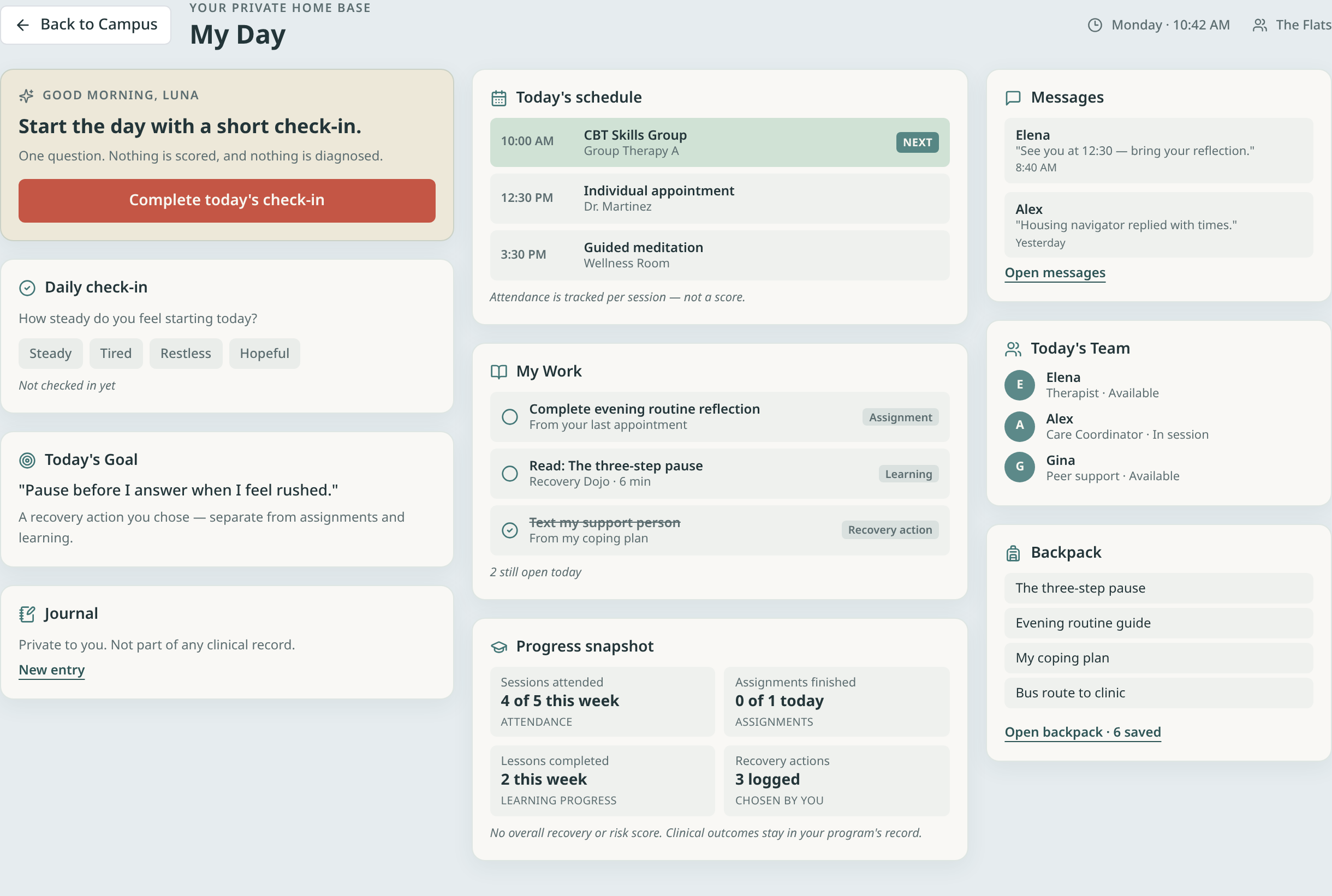
Every participant in Recovery Campus has a personal workspace where their schedule, assignments, recovery goals, learning activities, treatment team, resources, and progress come together.
It's called My Day.
Instead of navigating disconnected appointments, messages, documents, and applications, participants begin each day inside their own space within your virtual treatment facility. They can see what's next, understand what's expected, access what they need, and actively participate in treatment throughout the day.
For clinicians and program operators, those everyday activities become part of a connected picture of treatment engagement, participation, and progress.
One personal workspace. An entire treatment experience connected behind it.
Beyond the appointment
A Treatment Program Should Be More Than a Schedule of Appointments
Behavioral health treatment involves much more than attending sessions. Participants learn new skills, practice coping strategies, complete assignments, work toward personal goals, communicate with their treatment team, access resources, and take recovery-related actions between appointments.
Yet in many virtual programs, those activities are spread across different systems. The video session happens in one place. The assignment arrives through another. The participant's schedule lives somewhere else. Important resources disappear into messages, attachments, or forgotten browser tabs.
The actual work of treatment becomes fragmented.
My Day brings the participant's daily treatment experience together in one place.
It gives structure to the entire day, not just the scheduled clinical encounter. And because My Day exists inside Recovery Campus, it connects each participant to the larger treatment environment, including groups, clinicians, learning resources, community spaces, and other program activities.
Interactive tour
Explore Your Participant's Workspace
Select a feature to see what it does and why it matters — then read the full story below.
Today's Schedule
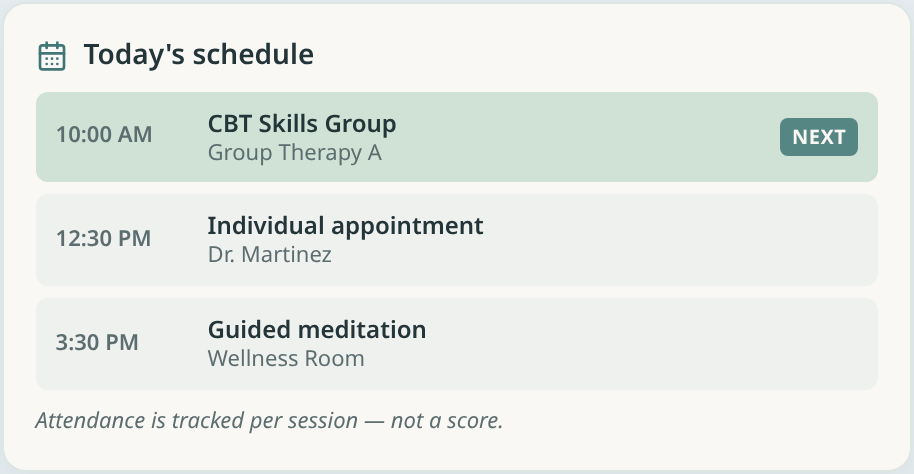
Appointments, groups, therapeutic activities, and program events in one clear timeline — each connected to its place in the treatment program.
- Participants know where they're expected and what's coming up
- No more reconstructing the day from scattered invitations
- Scheduled sessions connect to attendance and participation information for staff
Inside the workspace
Inside My Day: Everything Participants Need to Move Through Treatment
A participant opens My Day and immediately sees a personalized view of their treatment day. Not a complicated clinical record. Not a generic collection of software tools. A practical, organized workspace built around what they're doing, what comes next, and how they're progressing.
01
Today's Schedule: Know Where to Be and What's Next
The daily schedule brings appointments, groups, therapeutic activities, and other program events into a clear timeline. A participant might see:
- 10:00 AM — CBT Skills Group
- 12:30 PM — Individual appointment
- 3:30 PM — Guided meditation
Each activity connects to its place within the treatment program. Participants no longer have to reconstruct their day from scattered invitations or search for the right meeting link. They know where they're expected, what's coming up, and how their schedule fits into the larger program.
For treatment teams: Scheduled sessions connect to attendance and participation information, helping staff understand what was expected, what occurred, and where follow-up may be needed.
02
Daily Check-Ins: Make Room for How Someone Is Doing
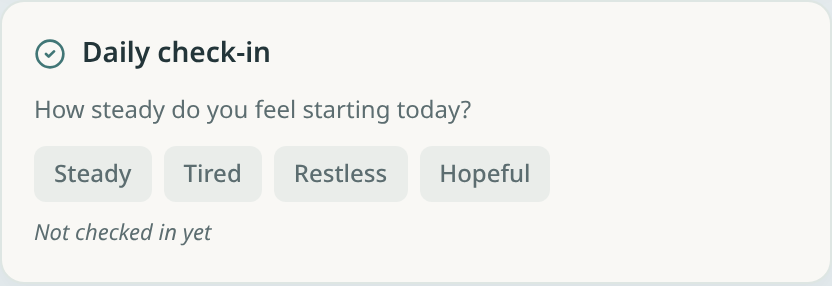
Treatment begins with the person, not just the schedule. My Day provides a simple daily emotional check-in, allowing participants to indicate how they're feeling as they begin their day. Steady. Tired. Restless. Hopeful.
These brief interactions create a natural opportunity for reflection without turning every visit into another lengthy assessment. Participants can establish a habit of noticing how they feel, while the program gains additional context about their experience over time.
Rather than relying exclusively on episodic appointments and retrospective conversations, clinicians can consider daily check-in patterns alongside attendance, assigned work, and other treatment activity.
The value isn't the check-in alone. It's how everyday observations become part of a more complete picture.
03
My Work: Turn Treatment Assignments Into Action
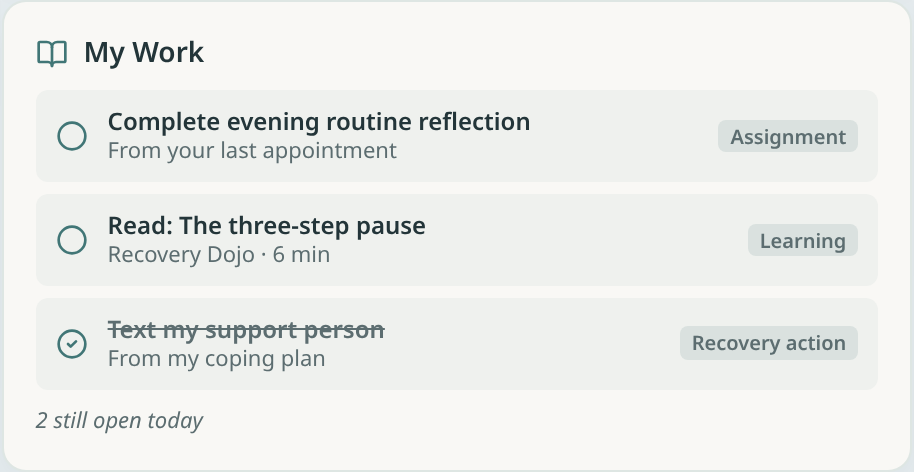
There is a significant difference between giving someone homework and creating an environment where they can actively work on it. My Work places therapeutic assignments, learning activities, and personal recovery actions directly inside the participant workspace.
Participants see what needs attention and can move into the relevant activity. Assignments might include an evening routine reflection. Learning might involve a brief Recovery Dojo lesson. A recovery action might involve reaching out to a support person or practicing a specific coping strategy. Each belongs to a larger treatment journey.
The participant knows what to do. The clinician can see whether assigned work is being completed. And the program can connect the activity to broader treatment goals.
Learning becomes practice. Practice becomes action. Action becomes visible progress.
04
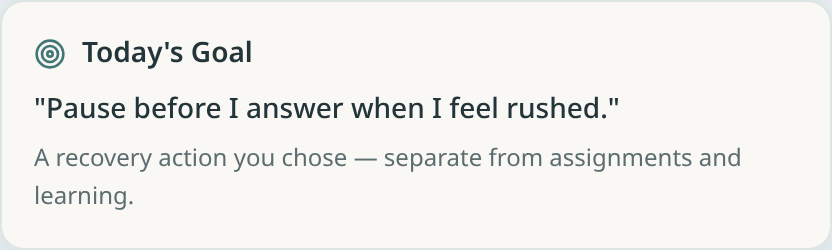
Today's Goal: Keep Recovery Personal and Practical
Clinical treatment plans can contain important objectives that are difficult to translate into everyday behavior. My Day brings those objectives closer to daily life through a visible, participant-centered goal. For example:
"Pause before I answer when I feel rushed."
That may seem like a small action, but it can represent meaningful work in emotional regulation, impulse control, communication, and recovery. A daily goal helps participants connect what they're learning in treatment to something they can practice in real life.
Goals can stand apart from formal assignments, allowing participants to take ownership of specific behaviors they want to change. Instead of treatment being something that happens only during a scheduled session, it becomes something the participant can practice throughout the day.
05
Progress Snapshot: Make Participation and Accomplishment Visible
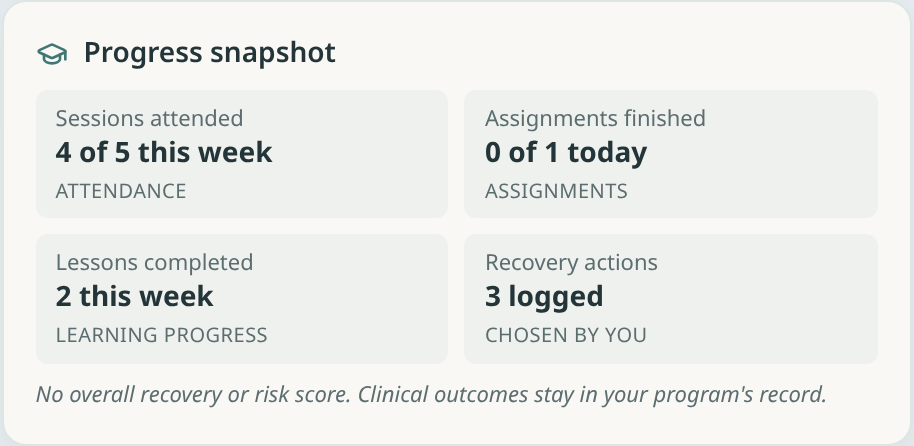
Progress isn't always obvious to someone going through treatment. A participant may be attending groups, completing lessons, doing assignments, and taking important recovery actions without recognizing how much they've accomplished. My Day makes those activities visible. The Progress Snapshot organizes participation into meaningful categories, including:
- Sessions attended
- Assignments completed
- Lessons finished
- Recovery actions taken
A participant can see evidence of their effort accumulate over time. Four of five scheduled sessions attended. Two lessons completed. Three recovery actions logged. These are not declarations of clinical recovery or substitutes for outcome measures. They're concrete reminders of what the participant has done. They help turn an abstract treatment experience into a series of recognizable accomplishments.
For the treatment team, those same activities become useful indicators of engagement and follow-through. For program leadership, they contribute to a better understanding of how participants interact with the treatment model.
The participant sees their work. The program can see the treatment process happening.
06
Messages: Keep Communication Connected to Care
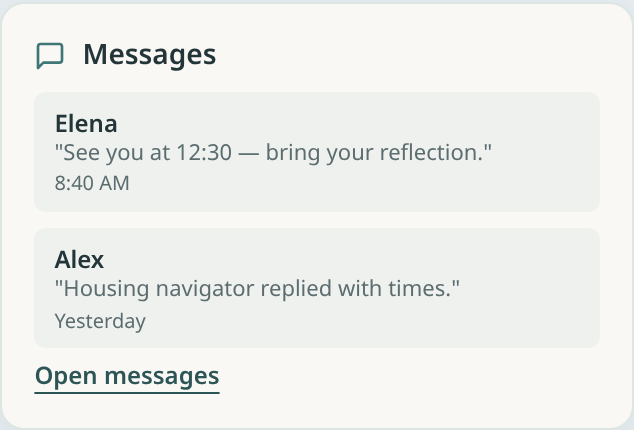
Participants need to communicate with their treatment team throughout the day, not just during appointments. A clinician may send a reminder about a reflection. A care coordinator may provide information about housing resources. A participant may need to locate an earlier conversation.
My Day places messages inside the same environment where treatment activities occur. This makes communication part of the participant's daily workflow rather than another separate application to monitor. Participants can see recent messages and move directly into their communications.
For treatment organizations, connected messaging supports continuity between appointments, assignments, practical support, and follow-up activity.
07
Today's Team: Make the People Behind Treatment Visible
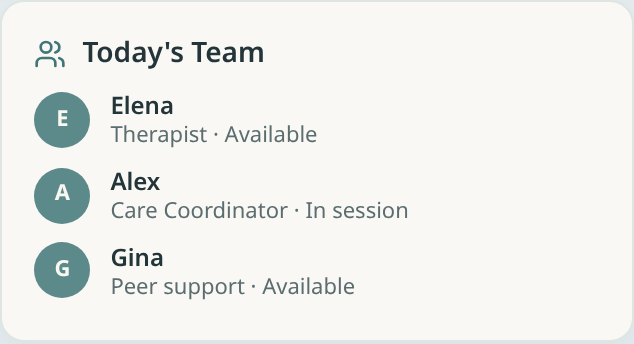
One of the challenges of virtual care is that the treatment organization can feel invisible between scheduled sessions. My Day helps address that by giving participants a clear view of the people supporting them.
A participant can see their therapist, care coordinator, peer support staff, and other relevant team members, including available presence or status information. These aren't simply names stored in a directory. They are the people who make up the participant's treatment environment.
Keeping the treatment team visible reinforces the idea that the participant belongs to an ongoing program with identifiable staff and support, rather than a succession of unrelated telehealth appointments.
08
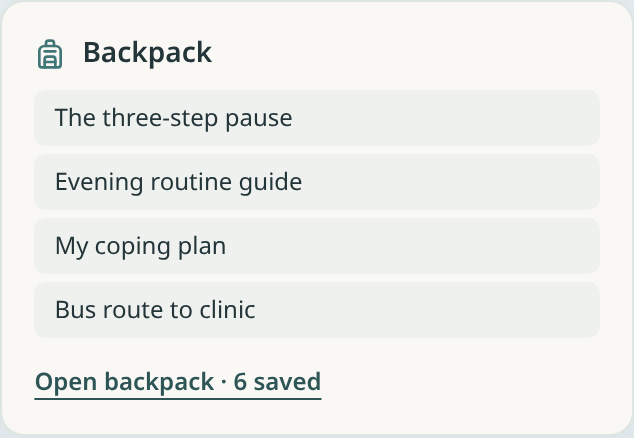
Backpack: Keep Important Recovery Resources Within Reach
Participants accumulate valuable materials throughout treatment. Coping strategies. Worksheets. Recovery plans. Practical resources. Learning materials. Personal reminders. Information about outside services. Those resources are most valuable when they're accessible at the moment they're needed.
The Backpack gives participants a persistent place to keep and revisit their saved resources. A participant might return to a three-step pause exercise after a difficult interaction, reference an evening routine guide at home, or access a coping plan between treatment sessions. Resources can also include practical care-coordination information, such as housing, employment, transportation, or community support.
The Backpack extends the usefulness of the treatment experience beyond the moment a skill was originally introduced.
Treatment materials don't have to disappear when the session ends. They travel with the participant.
09
Personal Journal: Create Space for Private Reflection
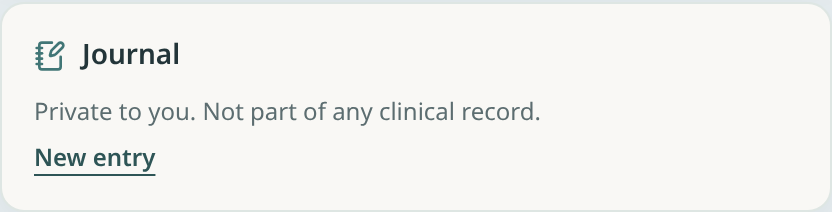
Not every thought a participant has needs to become part of their clinical documentation. My Day includes a personal journal that gives participants space to write, reflect, and process their experiences.
The journal is explicitly identified as private and separate from the clinical record. This distinction matters. Participants benefit from having an environment that supports personal reflection without making every entry feel like a formal clinical submission.
The journal complements structured assignments and check-ins, giving participants another way to engage with their treatment experience on their own terms.
The hours around the sessions
What Happens Between Groups Matters
A virtual intensive outpatient program may have several hours of scheduled treatment in a day, but the participant's experience continues beyond those sessions. They may have a difficult conversation at home. Encounter a trigger. Need to practice a skill. Remember an assignment. Look for a saved resource. Or simply need to reconnect with their treatment routine.
Without a persistent treatment environment, those moments may happen entirely outside the program's digital experience. My Day changes that. The participant has somewhere to return. They can review a goal, open a coping strategy, complete an assignment, access a Recovery Dojo lesson, read a message, or see what comes next. Their connection to the program doesn't have to disappear between appointments.
Recovery Campus gives virtual treatment programs an actual facility online. My Day gives each participant a personal place to work inside it.
One workspace, every perspective
Built for Participants. Valuable Across the Treatment Organization.
My Day is designed around the participant experience, but the activity inside it benefits the people responsible for delivering and managing treatment. Choose a role:
A personal place to work through treatment
A participant opens My Day and immediately sees a personalized view of their treatment day. Not a complicated clinical record. Not a generic collection of software tools. A practical, organized workspace built around what they're doing, what comes next, and how they're progressing.
They can see what's next, understand what's expected, access what they need, and actively participate in treatment throughout the day — with somewhere to return between appointments.
Connected activity
Every Participant Action Can Create Value Beyond the Participant
Consider a simple example. A clinician assigns a lesson on emotional regulation. The participant finds it in My Work, completes the lesson, saves a coping tool to their Backpack, and later logs a recovery action after using that tool.
For the participant, this is a straightforward treatment experience. For the clinician, it provides evidence of learning, practice, and follow-through. For the program director, it demonstrates engagement with the organization's curriculum. For operations and quality teams, it contributes structured information about how treatment activities are delivered and completed. For Clinical IQ, those interactions become part of a longitudinal record that can be considered alongside attendance, self-report, standardized measures, and other clinical information.
One participant journey can inform many aspects of care without requiring each department to reconstruct it independently. This is one of the central advantages of operating a treatment program inside a connected digital facility.
A More Complete Picture of Treatment Engagement
Traditional treatment records capture important clinical events, including assessments, session notes, diagnoses, treatment plans, and outcomes. My Day adds another dimension: the activity that takes place as a participant moves through treatment. It can connect:
- Scheduled
- Attended
- Learned
- Practiced
- Completed
- Progress
The individual participant experience on the left feeds organizational insight on the right — engagement information, not clinical scores.
When these activities are captured within the same environment, they become easier to understand together. A participant's engagement isn't reduced to whether they attended their last appointment. The program can also see whether assigned work was completed, lessons were accessed, recovery actions were taken, and daily participation patterns changed.
Combined with clinical observations, self-report, and measurement-based care, these behavioral indicators support a richer understanding of the treatment experience. They also create the foundation for clinical engagement analysis, quality improvement, utilization review, program evaluation, and Clinical IQ.
A physical program can observe treatment. Recovery Campus can measure how someone moves through it.
Part of something bigger
Part of Something Bigger: Campus Operations
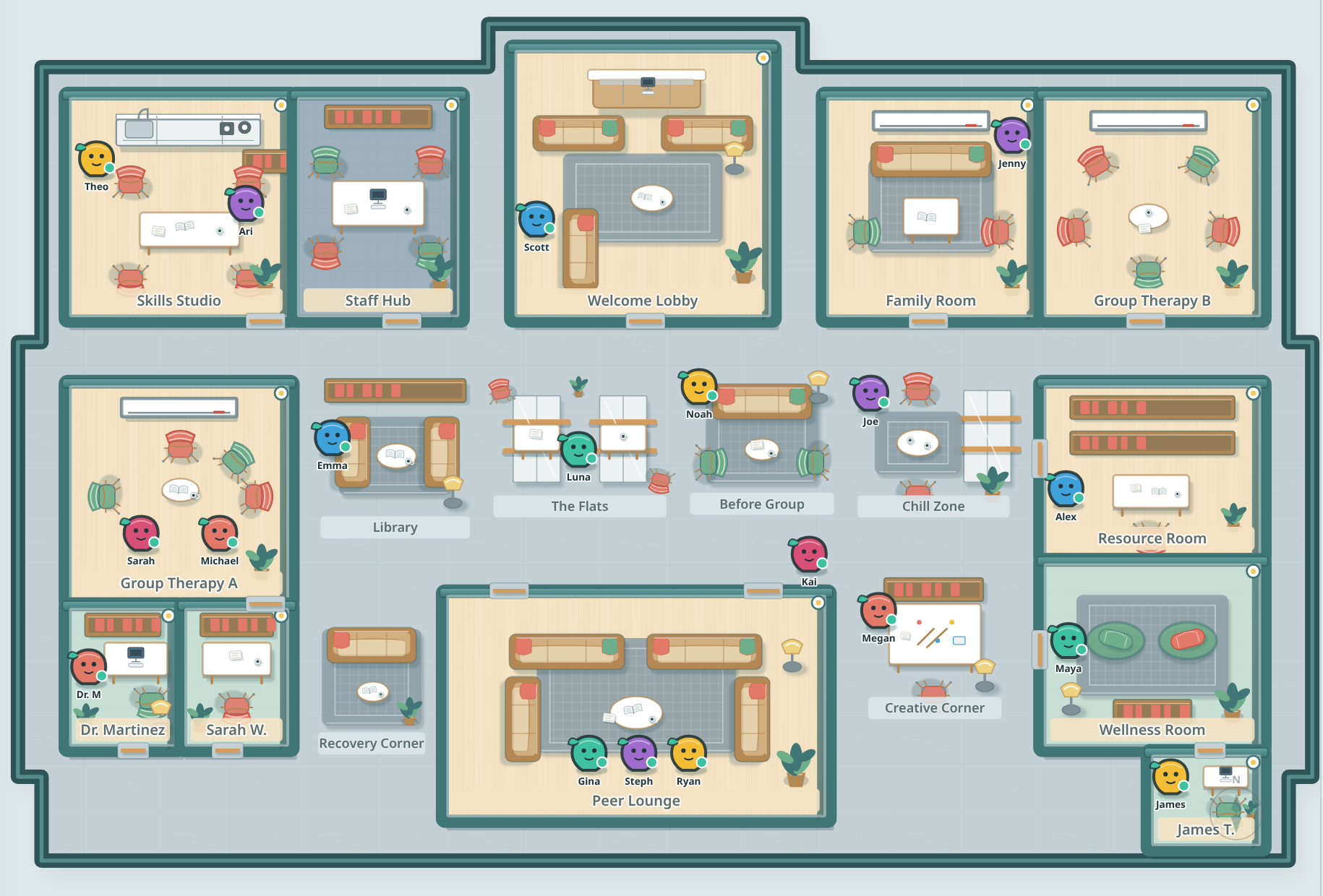
My Day is one of the interconnected environments that make up Recovery Campus. Participants use their personal workspace to organize and complete daily treatment activities. They also move throughout the virtual facility to attend groups, meet with clinicians, engage with learning resources, connect with their community, and access additional services.
Meanwhile, staff operate within their own connected workspaces. The larger Campus Operations system brings these experiences together, connecting the participant journey with clinical activity, staffing, program delivery, engagement information, and organizational workflows.
My Day is the participant-facing starting point for much of that activity. The facility provides the environment. The workspaces provide the tools. The connected system provides visibility into how the program operates.
Built for your model
Designed for Virtual IOP and Behavioral Health Programs
My Day can support a range of behavioral health treatment models, including substance use disorder treatment, mental health services, virtual intensive outpatient programs, partial hospitalization programming, outpatient services, and hybrid treatment models.
For an established treatment center, it provides a more integrated participant experience within a broader virtual program. For a new virtual IOP, it offers an organized environment for building the daily treatment experience around more than appointments. For a solo clinician or smaller practice developing a structured program, it provides a foundation for coordinating sessions, assignments, resources, and participant activities as services expand.
The principle remains the same: Give participants a real place to engage in their care, then connect that engagement to the people and systems delivering treatment.
Questions programs ask
Frequently Asked Questions
What is My Day in Recovery Campus?
My Day is the personal participant workspace inside Recovery Campus. It brings together daily treatment schedules, assignments, goals, check-ins, learning activities, messages, saved resources, journal access, and progress information within a single virtual treatment environment.
Is My Day a behavioral health patient portal?
My Day includes capabilities commonly associated with patient portals, but its purpose is broader. Rather than primarily providing access to records, messages, and appointments, it serves as an active treatment workspace where participants complete work, practice skills, track activities, and engage with their program.
Can My Day support virtual intensive outpatient programs?
Yes. My Day is designed for structured treatment models such as virtual IOP, where participants may attend multiple groups, individual appointments, and therapeutic activities while completing assignments and practicing skills between sessions.
Can clinicians monitor participant engagement?
Yes. Activities such as attendance, assignments, learning, and recovery actions contribute to the connected Campus Operations environment, where treatment teams can view engagement information and identify patterns in participant follow-through.
Does My Day replace an electronic health record?
Recovery Campus integrates with EHR systems while providing the interactive environment where participants and staff engage in daily treatment activities. Contact Recovery Campus to discuss compatibility with your organization's EHR.
Can participants access resources outside group sessions?
Yes. The Backpack provides access to saved coping tools, educational materials, recovery resources, and other useful information. Participants can also return to their workspace to review goals, assignments, messages, and other activities.
Does My Day work for mental health treatment as well as substance use treatment?
Yes. My Day supports behavioral health programming broadly, including mental health and substance use treatment, through customizable daily treatment activities, learning, goals, assignments, and participant engagement workflows.
How does My Day connect to Clinical IQ?
My Day creates structured information through everyday treatment activities. Within the broader Recovery Campus system, that activity can contribute to Clinical IQ's analysis of engagement patterns and behavioral changes alongside other clinical and program information.
Step inside
See What a Participant's Day Actually Looks Like
The easiest way to understand My Day is to step inside. Explore the interactive Recovery Campus environment, enter the participant workspace, review the daily schedule, open assignments, visit the Backpack, and see how treatment activities connect.
Don't just see what a virtual treatment program offers. See how it operates.
My Day — Participant Workspace
Give every participant a place to work.
My Day is one of 17 interconnected room and workspace experiences that form the larger Recovery Campus operating environment.