Group Therapy | Inside Recovery Campus
Give Every Virtual Group an Actual Treatment Room
Group Therapy in Recovery Campus gives participants a place to enter, prepare, meet their group, access materials and continue afterward—all inside their program’s own virtual treatment facility. It is more than a video meeting link. It is where the group experience lives.
The Group Therapy room is included in the base Recovery Campus package. Each treatment program chooses how live video connects: integrate a supported video service via API for video within the room, or add its meeting links for scheduled sessions. Both paths keep the surrounding Campus room experience; the meeting-link option may open the call outside the room rather than embed it.
The group begins before anyone turns on a camera
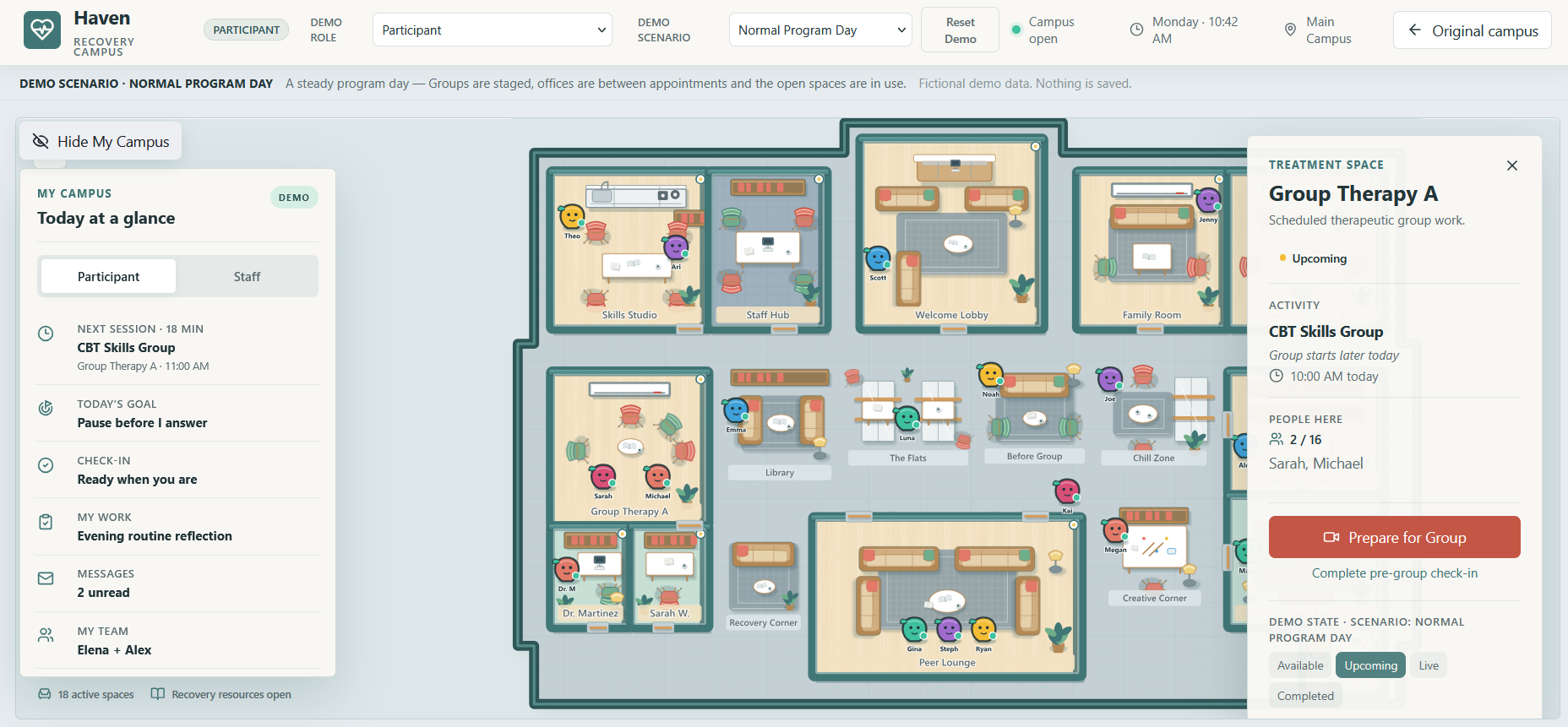
Imagine it is ten minutes before a CBT Skills Group. A participant has already found Group Therapy A on the Campus map. The side panel identifies the room, shows the upcoming session and scheduled time, names the people present, and offers two practical actions: Prepare for Group and Complete pre-group check-in. There is a destination and a clear next step before the session starts.
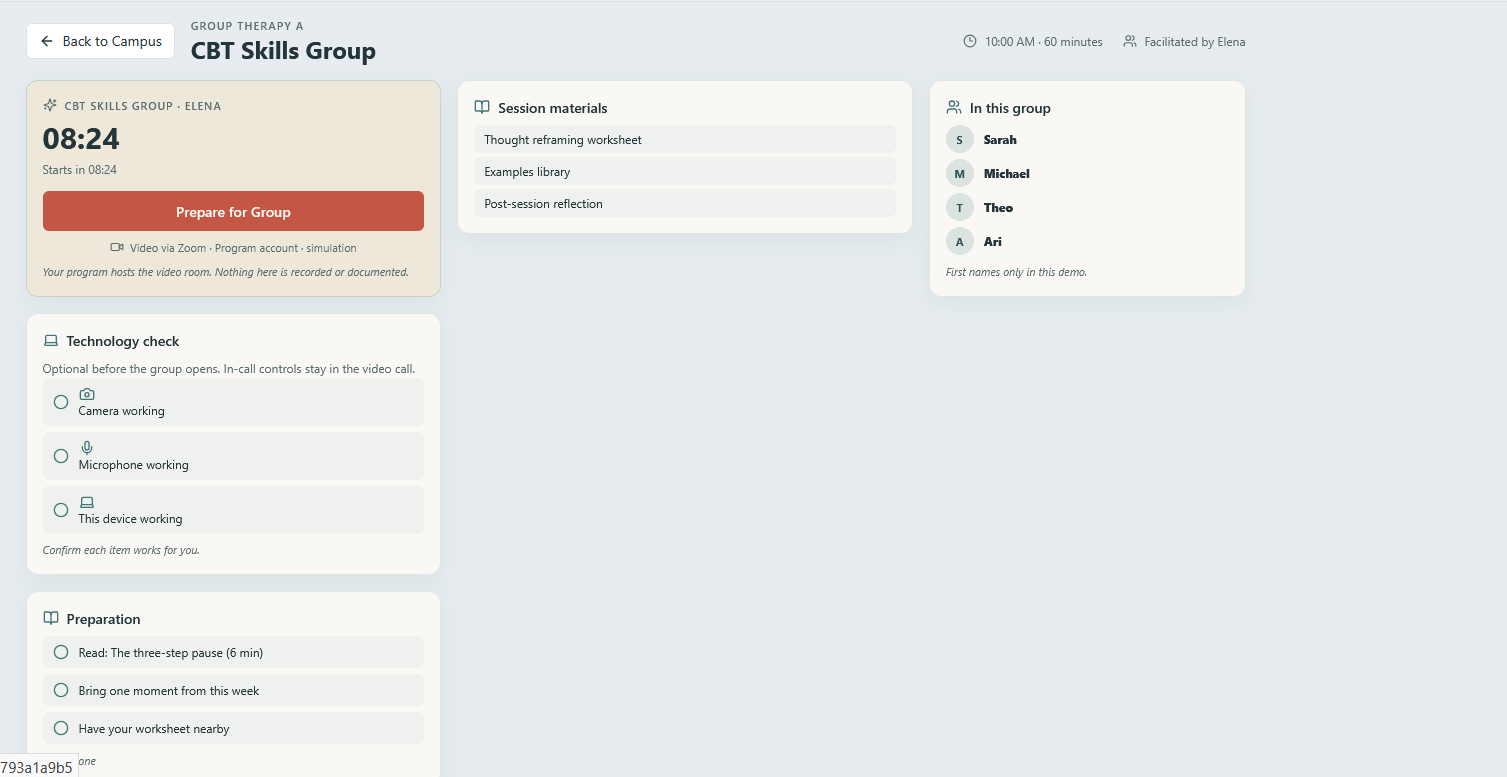
Step inside, and the room gives that preparation shape. A countdown marks the time remaining; the group title and facilitator are visible; session materials sit nearby; technology checks cover camera, microphone and device; and a short preparation list helps the participant arrive ready. Group delivery is not isolated from the activities around it.
For someone trying to establish a routine in virtual treatment, the difference matters. Instead of searching emails, finding the correct meeting link, wondering who is there, or arriving unprepared, they can return to a familiar place. Recovery Campus gives the schedule a location and gives participation a beginning, middle and next step.
Two genuine views of the same treatment room
- Campus map
- Room context sidebar
- Room preparation
- Check-in, tech & materials
- Video meeting
- Post-session reflection
1. On Campus: the room has identity, time, people, and a next action
The original Campus screenshot shows Group Therapy A, its purpose (“Scheduled therapeutic group work”), upcoming CBT Skills Group, time, people present, and buttons to prepare for group or complete a pre-group check-in. The room sits in the shared Campus environment; participants can see their daily priorities as they navigate.
2. Inside the room: prepare, attend, return
The original inside-room screenshot shows the CBT Skills Group interface with session timing, facilitator, countdown, Prepare for Group button, session materials, technology checklist, preparation steps, and a participant roster. It also shows post-session reflection among the materials. The lower-right area is specified as the place for embedded live video when an API integration is configured; the screenshot itself does not show a live embedded call. Avoid representing that blank area as a completed live video feed.
A full group journey, not just a meeting
Arrive and orient
The participant finds the correct Group Therapy room on the map and sees which session is coming up. Visible room states and presence create the simple cues of walking toward a group that is assembling: where to go, when it starts, and who may be there.
Check in before group
The pre-group check-in is a distinct step in the room experience. It can make preparation explicit rather than assuming that joining the call equals being ready. Programs can use pre-group activity in keeping with their workflow; the landing page should not claim that answers automatically become clinical documentation.
Prepare for the technology
A camera, microphone and device readiness checklist reduces avoidable surprises. Technology checks are a useful practical ritual for remote care, particularly for participants who may be joining from different devices or locations. They do not replace the video provider’s in-call controls.
Prepare for the subject
The CBT example includes a brief reading, a prompt to bring a moment from the week, and a worksheet reminder. These are concrete ways to enter the session with something to contribute. Different programs may supply different materials and group formats; the room creates a consistent home for those preparations.
Attend the live group
Live video belongs to the Group Therapy service in the base Campus offering. Programs may connect it by video API, bringing the live session into the room interface where supported, or choose to add the appropriate meeting links themselves. Do not flatten these into identical experiences: one can keep video on the room page; the other can send participants to the provider’s meeting experience. The central benefit is that participants know where the group lives and how to reach it.
Return for reflection and follow-through
Group has an afterlife. Session materials, post-session reflections and suggested next actions remain associated with the same treatment destination. Instead of a session disappearing after the call, a participant has somewhere familiar to look back, reflect and continue work when the group ends.
Virtual group therapy for real programs, not just appointments
For virtual intensive outpatient programs, partial hospitalization programs and other group-based behavioral health services, the group is often the most visible part of the treatment day. But a group session is not only its scheduled duration. There is preparation, joining, facilitation, presence, materials and follow-through. Bringing those steps into one recognizable space makes the program easier to navigate and easier to explain.
A good virtual group room does not pretend to be an EHR. It gives treatment its own front door. Clinical documentation and billing systems can remain where they belong, while participants and staff use a real program environment to arrive, prepare and participate.
What each stakeholder gains
Participants: knowing where to go
Clear upcoming session details, countdown, named facilitator, presence, readiness checks and session materials replace a string of disconnected instructions. Seeing peers and understanding the room’s purpose can make virtual treatment feel less anonymous. The room creates repeatable habits: find group, check in, prepare, join, return.
Group facilitators: a more prepared room
Facilitators can orient around a session roster, timing, materials, participant preparation and room state. They can connect group content to pre-group exercises and post-group reflection rather than handling those elements as separate email threads. Preparation supports facilitation; it does not substitute for professional judgment.
Therapists: continuity beyond one appointment
A therapist can point participants toward a familiar Group Therapy room and connect assigned materials to the session that inspired them. When the system is configured to capture relevant activity, readiness and follow-through may add context for conversations. Do not promise access to confidential clinical information or automatically inferred outcomes.
Care coordinators: participants actually get there
The care coordinator is the participant-success partner who sends itineraries, offers warm reminders, notices when somebody is late, reaches out when a person misses group, troubleshoots access issues, and helps remove barriers on the way to graduation. Group Therapy gives this role a specific session and destination to help participants reach. The coordinator’s broader daily dashboard belongs in Staff Hub.
Clinical and program leadership: a repeatable group model
The program can establish familiar entry, preparation and attendance-related routines across groups. Leadership can distinguish an upcoming group from one needing operational attention, improve staff handoffs, and evaluate whether the intended workflow is followed. Future quality reporting should be described as dependent on actual implementation and data capture, not as a promise of automatic payer evidence.
Owners and referral partners: make virtual care visible
Group Therapy is compelling evidence that Recovery Campus is a facility, not a sequence of teleconference invitations. A buyer, prospective referral partner, family member or program leader can see what it means for a participant to enter a structured virtual group environment—before, during and after the session.
Bring your own video workflow
Both connection approaches belong to the base Group Therapy offering; the program determines how it wants to run its sessions. Do not imply a named video vendor is required, that all APIs are supported, or that links automatically produce an embedded session.
The value of an actual treatment facility online
In a physical treatment program, people know where group takes place. They walk into a room, orient themselves, see familiar faces, and prepare to participate. Recovery Campus translates that basic organizing power into virtual care. Group Therapy is a real destination within a larger online facility where participant work, resources, learning and staff operations also have places.
The video system becomes a delivery choice. The Group Therapy room is the experience that holds everything together.
Questions programs ask
Frequently Asked Questions
What is Group Therapy in Recovery Campus?
A dedicated room inside a virtual treatment facility where participants see their scheduled group, prepare, complete pre-group activities, access materials and connect to the live session.
Is Group Therapy included in the base Recovery Campus package?
Yes. The Group Therapy environment is part of the base offering, with the program choosing how to connect live video sessions.
Does the video session happen directly inside the room?
It can when the program uses a supported video API integration. Programs may alternatively provide meeting links, in which case the call may open in the video provider’s own interface.
Do we have to use Zoom or Google Meet?
The program chooses how to connect video. The page should not claim specific providers or API availability beyond what has been confirmed for an implementation.
Can participants prepare before group?
Yes. The illustrated room includes a countdown, technology checks, preparation checklist, group details and session materials, along with a pre-group check-in path.
Can participants see who is in the group?
The demonstration shows a group roster and room-presence information. Real access and visibility depend on role permissions and the program’s configuration.
Does Group Therapy replace our EHR?
No. It is the treatment-delivery environment for the participant and staff experience, not a replacement for clinical records or billing systems.
Can this work for virtual IOP or other group programs?
Yes. The room model is applicable to virtual intensive outpatient and other behavioral health programs that deliver scheduled groups.
What happens after the group ends?
Materials and post-session reflection can remain associated with the room so participants can return for follow-through.
Does the system automatically capture clinical outcomes or claims?
No such claim should be made. Attendance, preparation and activity data have different meanings, and any documentation or reporting capability depends on actual configured workflows.
Group Therapy | Inside Recovery Campus
Stop sending participants to a meeting. Give them a group room.
Experience how Group Therapy connects the room, the preparation, the session and the next step—all inside Recovery Campus. Explore the interactive facility and ask how your program can connect live group video using either API integration or its own meeting links.