Inside the virtual treatment facility
Resource Room — A place to explore what matters to you
Inside Recovery Campus, participants have a dedicated room to browse useful information, discover media and resources, follow their interests, and return whenever they want — without an assignment or appointment.
Recovery Campus is a white-labeled online facility for virtual treatment programs — not a collection of telehealth links. The Resource Room is one of the rooms that makes it a facility: a place participants can walk into on their own, between sessions, to explore whatever matters to them.
What it is
A room of their own, inside the program
Treatment fills the schedule. The Resource Room fills the space around it.
In a residential program, there is always somewhere to wander: a shelf of books, a bulletin board, a corner with pamphlets and a comfortable chair. Virtual programs rarely have an equivalent. The session ends, the video call closes, and the participant is back in their own browser tabs — alone with the open internet at exactly the moment curiosity, worry, or boredom shows up.
The Resource Room gives that impulse a place to go. It is a participant-facing room on the campus map where people browse curated media and resources on anything relevant to their interests and life: sobriety and recovery, relationships, family, hobbies, personal growth, finance, housing, work, transportation, community, wellness — whatever the participant cares about. Videos, podcasts, articles, practical guides, and links live here, organized so a person can follow a question instead of a syllabus.
It is deliberately non-clinical. There are no treatment plans here, no mandated education modules, no assignments. A participant does not need a reason to be in the Resource Room, the same way they would not need a reason to pick up a magazine in a waiting room. That is the point: the room belongs to them.
Two neighbors deserve a clear distinction. The Recovery Dojo is where structured skills curriculum lives — guided lessons and practice with a defined path. The Resource Room is the open-ended complement: self-directed discovery with no set sequence. And the Library is a separate, reserved zone on the campus with its own purpose — the Resource Room is not the Library, and the two should never be conflated.
How participants get there
A real place on the map, not a menu item
The path to the Resource Room is the same as the path to anywhere else on campus: see it, walk up to it, go in.
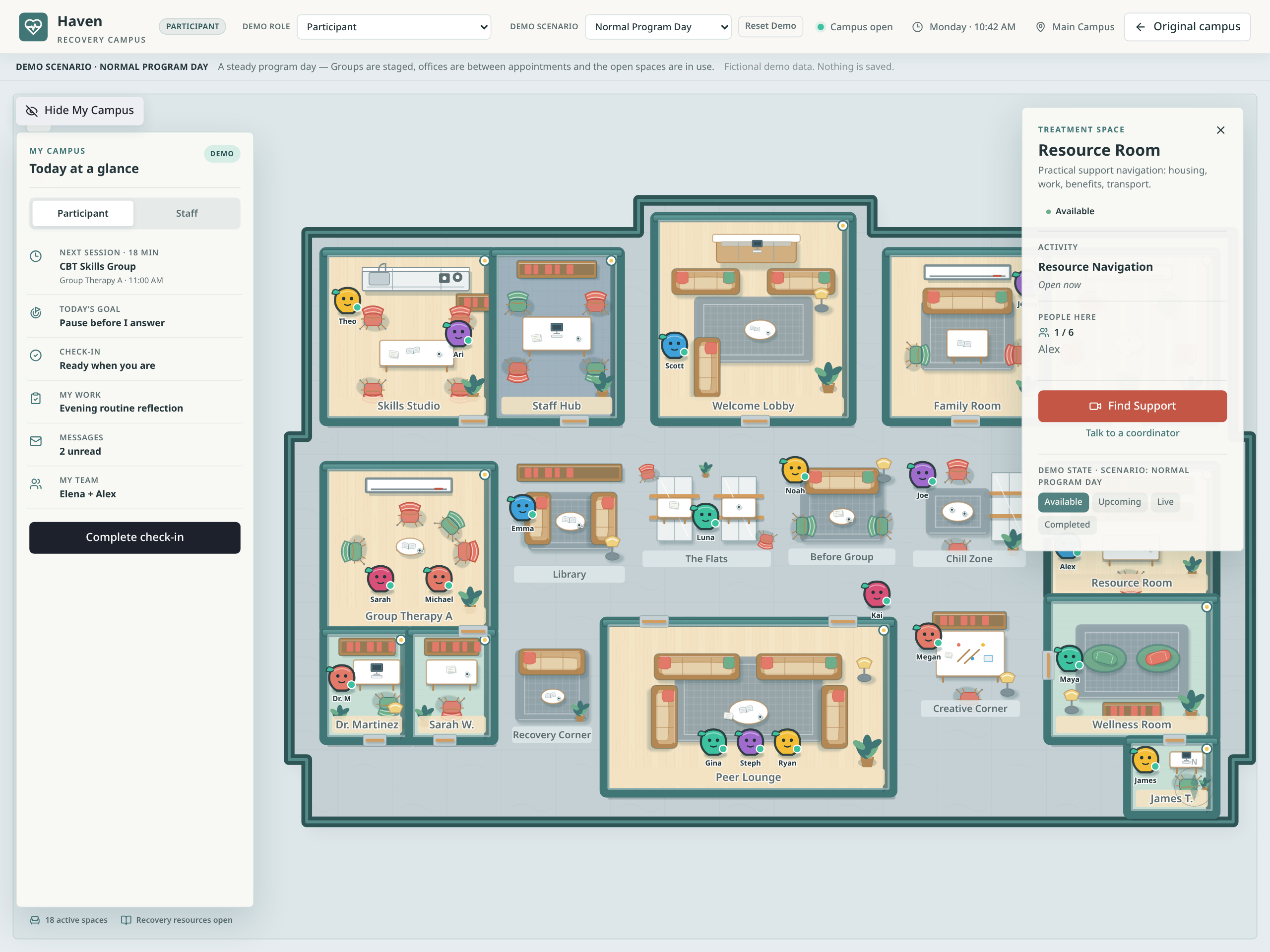
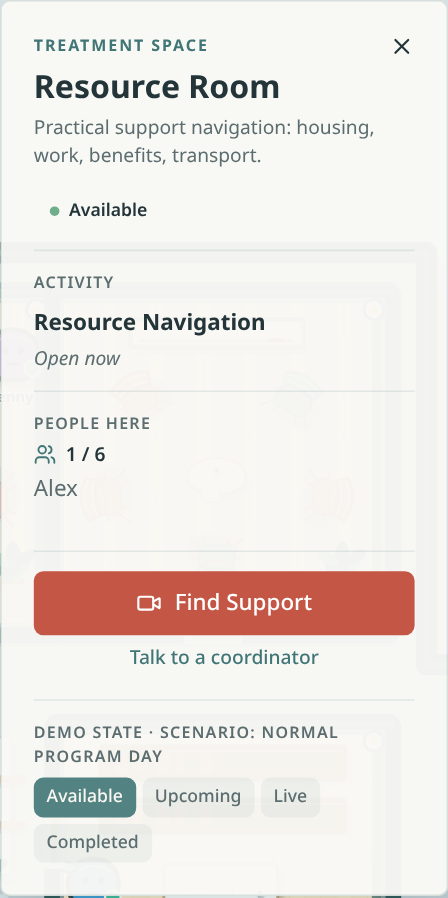
This spatial path matters more than it might seem. When support lives at a URL in a text message, it is forgotten. When it lives in a room the participant has walked into before — a room they can picture, on a campus they can mentally map — it becomes part of the routine. Place creates memory, and memory brings people back.
All screenshots on this page are genuine captures from the live demo campus with fictional data. Walk the interactive campus yourself
Self-directed by design
Browse by what you care about, not by what you were assigned
The Resource Room is organized around the participant's life, not the program's paperwork. Someone thinking about an apartment search browses housing. Someone rebuilding a relationship browses family. Someone who just wants to learn something new follows a hobby or a personal-growth thread. Recovery content is there — but so is everything else a whole person is made of.
This is a deliberate stance about engagement. People return to places that respect their curiosity. A room that only contains what the program wants them to read becomes another obligation; a room that contains what they want to find becomes a habit. The Resource Room is built to be the second kind.
Because the program curates the collection, participants get the freedom of the open internet without its noise. Every item in the room is something the program has chosen to put on its shelves — which means browsing is safe, relevant, and worth the time.
Formats people actually use
Videos, podcasts, articles, guides — and practical resources
Discovery comes in different formats because attention comes in different formats. A participant with ten minutes watches a short video. One on a long bus ride listens to a podcast. One facing a specific problem reads a practical guide. The Resource Room is built for media and resources in the forms people already reach for, so exploring feels like the rest of their digital life — except curated, and one room away from the rest of their program.
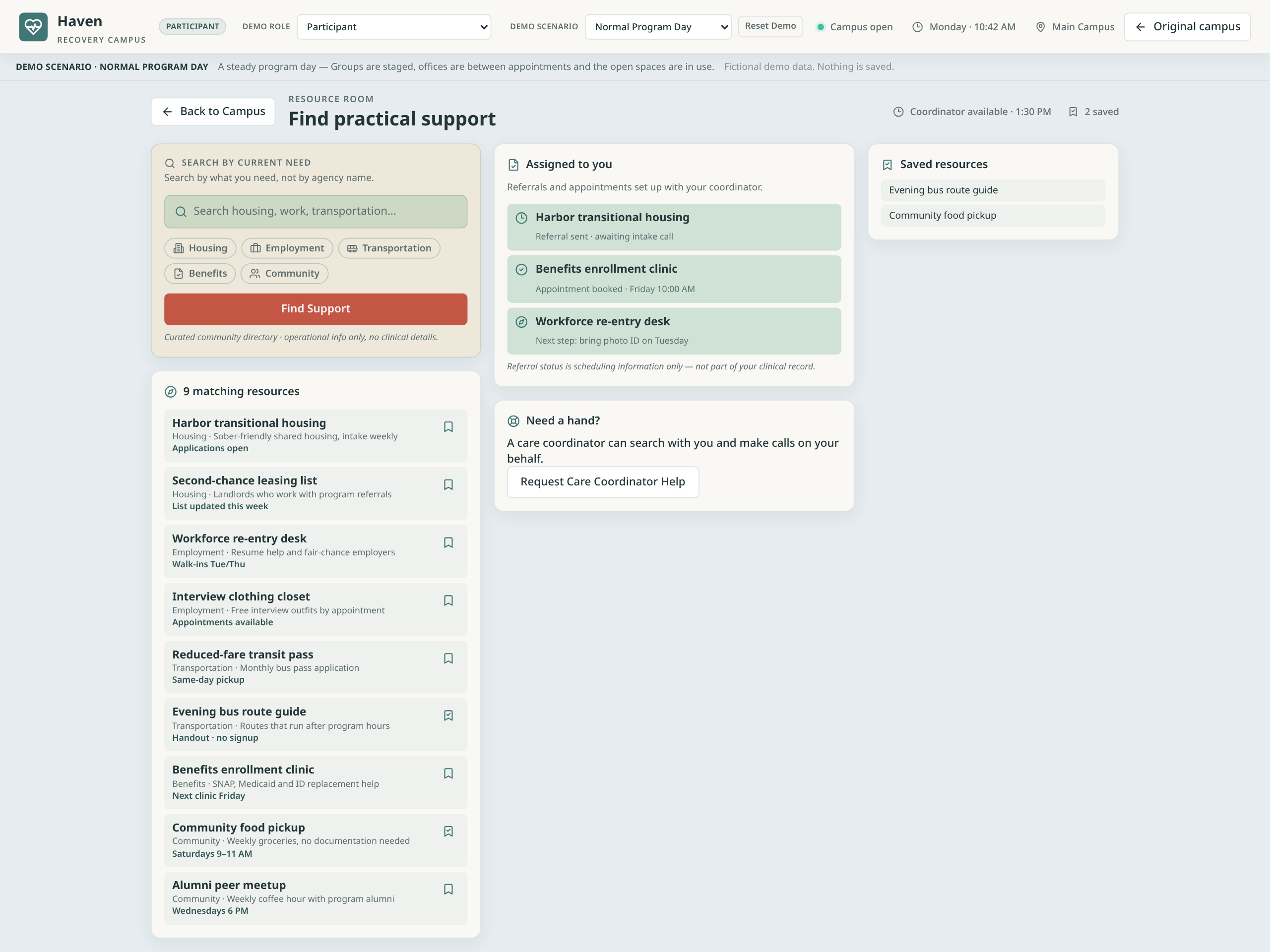
Practical life resources are one topic area among many. In the current demo campus, for example, the Resource Room's working view lets a participant search by need — housing, employment, transportation, benefits, community — and see matching local resources with plain details, save the ones worth keeping, and ask a care coordinator for a hand when searching alone is not enough. That functional view is one real example of the room in use, not the limit of what the room is for: the same shelves that hold a transit-pass guide hold a podcast series, a budgeting article, or a piece on repairing a relationship.
Interactive tour
Inside the room
Four things participants do in the Resource Room — each visible in the live demo campus.
Browse by Interest
Participants explore by what they care about — recovery, relationships, family, hobbies, personal growth, money, housing, work, transportation, community, wellness — not by program requirement. The room answers in the language of the person looking.
- No assignment, no appointment, no permission needed to walk in
- Topics reflect real life, not just the treatment curriculum
- Every entry carries practical detail: what it is, who it is for, and how to use it
Between sessions
Save it now, come back to it whenever
Most of a virtual program's life happens between scheduled sessions — and most programs leave those hours completely empty. The Resource Room is built for those hours. A participant who finds something useful at 10 PM on a Tuesday saves it, and it is still there on Thursday. Their collection grows with them: guides they mean to read, resources they might need, media worth revisiting.
This is what keeps a program tangible between sessions. The campus does not disappear when the group ends, and neither does the participant's place in it. The Resource Room gives the in-between hours somewhere to go — and gives the program a way to be present in a participant's week without scheduling a single additional appointment.
Help without friction
Self-directed does not mean alone
Independence works best with a person behind it. Every participant in Recovery Campus has a care coordinator — a success concierge whose job is to help them graduate: reminding them of schedules and sessions, noticing when they are running late, and removing the practical barriers that get in the way. The Resource Room is one of the places that relationship shows up.
When a participant cannot find what they need, one request brings the coordinator in to help. The coordinator's own working dashboard lives in the Staff Hub — the Resource Room stays the participant's space. The participant never has to know which system handles what; they just ask, and a person answers.
What it looks like in practice
One participant, one afternoon
- Opens the campus between sessions
- Walks into the Resource Room
- Searches a need in their own words
- Saves two finds for later
- Asks a coordinator for a hand
- Comes back tomorrow to keep exploring
No assignment, no appointment — just a place to go and a reason to return.
Why a room, not a list
More than a resource directory — a place in the facility
A directory is a list of links. The Resource Room is a place. It has a location on the campus the participant can picture, a door they have walked through, and a spot in their mental map of the program — right next to the rooms where group happens and where their people are. That spatial reality is what separates a virtual treatment facility from a stack of telehealth links.
Belonging follows from place. When a participant has rooms that are theirs — a room for their day, a room for their skills practice, a room for their curiosity — the program stops being something that happens to them on a schedule and becomes somewhere they are. The Resource Room is the clearest expression of that idea: nothing is required there, which is exactly why people go.
One workspace, every perspective
What the Resource Room means for each person
Somewhere to go with your questions
You get a room that is yours: browse what interests you, save what is useful, and come back whenever you want — no assignment, no appointment, no one looking over your shoulder. When you get stuck, a real person is one click away.
Part of the whole
One room in a connected campus
The Resource Room does not stand alone. A participant's day starts in My Day, their schedule, and their check-in; skills practice happens in the Recovery Dojo; and the Resource Room is where curiosity and practical life get a place. Each room is a destination, and together they make the program somewhere a person can actually be.
For staff, the same campus is visible at a glance — which rooms are active, where participants are spending time, and how the facility is being used. Recovery Campus works alongside your existing systems: the EHR records treatment, your telehealth tool delivers the call, and the campus is where the program actually lives.
Who it serves
Built for virtual IOP, SUD, mental health, and beyond
Any program whose participants live their lives between sessions benefits from a place those participants can go. Virtual intensive outpatient programs use the Resource Room to keep the week connected. Substance use and mental health programs use it to give recovery-adjacent curiosity — and everything else in a life — a safe, curated home. New and solo programs get a facility-grade resource space without building one; established centers get one that carries their brand and their collection.
Because the room is white-labeled, it is your shelves, your curation, your name on the door. Participants experience it as part of your program — because it is.
Questions programs ask
Frequently Asked Questions
What is the Resource Room in Recovery Campus?
The Resource Room is a participant-facing room inside the virtual treatment campus where people independently browse, search, and save curated media, resources, and information on whatever matters to them — recovery, relationships, hobbies, personal growth, finance, housing, work, transportation, community, wellness. It is a real destination on the campus map, not a link list, and it is open-ended: no assignment or appointment required.
Is the Resource Room the same as the Library?
No. The Library is a separate, reserved zone on the campus with its own purpose. The Resource Room is its own room with its own identity: self-directed discovery of media, resources, and practical information. The two are not interchangeable.
How is it different from the Recovery Dojo?
The Recovery Dojo offers structured skills curriculum — guided lessons and practice with a defined path. The Resource Room is the opposite complement: open-ended, self-directed exploration with no set sequence. Participants use the Dojo to work a curriculum and the Resource Room to follow their own curiosity.
Can participants search by what they need, not by agency name?
Yes. The room is organized around needs and interests — housing, work, transportation, benefits, community, and more — so a participant can search in their own words without knowing which agency or program to ask for.
Is the Resource Room a clinical tool?
No. It is a non-clinical space. There are no treatment plans, no mandated education, and no clinical documentation here. It exists so participants have a place in the facility to explore, learn, and find practical help on their own terms.
Can a participant get help from a real person in the Resource Room?
Yes. A care coordinator — the participant's success concierge — is built into the experience. Participants can request help finding something, and the coordinator's broader workflow (schedules, reminders, removing barriers to graduation) lives in the Staff Hub, not in this room.
Does the Resource Room replace our EHR or patient education system?
No. Recovery Campus complements your existing systems. The EHR records treatment; the Resource Room is where participants spend time between sessions exploring what matters to them. It is part of the facility, not part of the clinical record.
How does the Resource Room relate to Campus Operations?
The Resource Room is one room on the campus map. Staff see it as part of the whole facility at a glance; participants experience it as a place they can walk into any time. You can explore the live demo campus to see exactly how it sits in the environment.
See it in the live campus
Give your participants a place to explore — not just a list of links.
Walk the interactive demo campus and open the Resource Room yourself, or talk with us about what it would look like inside your program's own branded facility.